

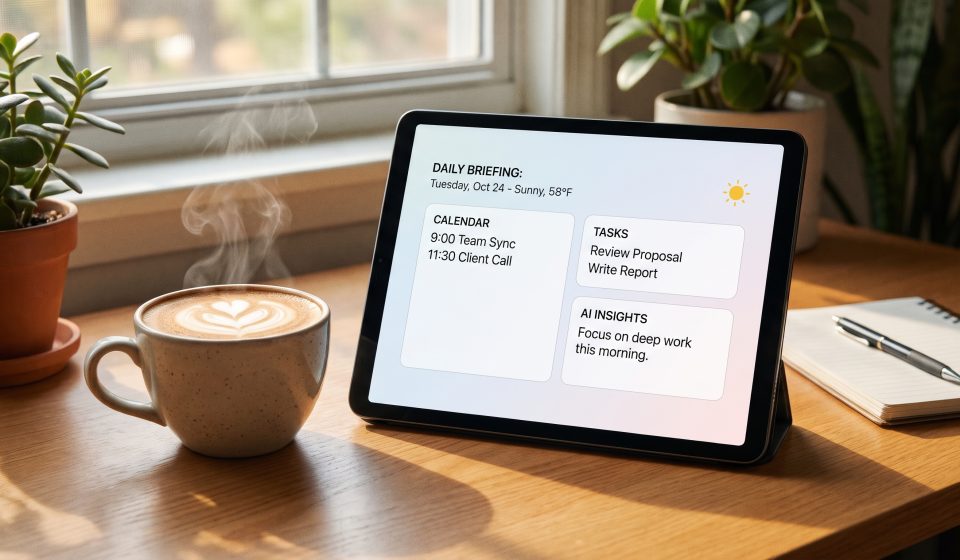

Claude Duet represents a new direction for Anthropic’s AI products: assistance that can become more proactive and connected to a user’s ongoing work.
Rather than requiring a fresh conversation for every task, the application is designed to help surface relevant information and support workflows across connected services.
Its announcement has raised an important question: what can Claude Duet actually do, and how might those capabilities help in everyday work?
Because Duet began as a limited research preview, users should distinguish announced features from integrations or capabilities that may become available later.
1. Proactive Daily Briefings
One of Duet’s central ideas is preparing useful information before users explicitly request it.
A daily briefing could help someone identify important tasks, relevant updates, and upcoming commitments.
The goal is to reduce the time spent manually gathering information from different sources.
However, the usefulness of any briefing depends on which information the assistant can access and how accurately it summarizes that context.
2. Information Organization
Modern knowledge work often involves information scattered across documents, messages, and project tools.
An AI agent may help bring relevant details together so users can understand the state of a project more quickly.
For example, a project manager might benefit from a summary of outstanding issues and recent decisions.
That is a practical scenario to evaluate, not a guarantee that every project-management integration is supported at launch.
3. Connected Application Workflows
Duet’s approach includes connected applications, allowing supported workflows to draw on relevant external context.
Connections can be useful when information is distributed across multiple services.
However, users should review what each integration can read or modify.
The presence of an integration does not necessarily mean every action in that service is available.
4. Task Preparation
AI agents can help users prepare for activities by gathering relevant context.
Meeting preparation is one example: an assistant may help organize background information and identify topics requiring attention.
Similar approaches could support project reviews, planning sessions, or recurring administrative work.
Actual workflows depend on supported features and user permissions.
5. Suggested Next Steps
Useful AI assistance often involves more than summarizing information.
An agent may help identify possible next steps based on available context.
For example, after reviewing a project summary, it might suggest clarifying an unresolved decision or preparing a follow-up.
Users should treat such suggestions as recommendations requiring judgment, not authoritative instructions.
6. Approval Controls
Anthropic has emphasized controls around actions performed through Duet.
This is important because different tasks involve different risks.
Reading a document is less consequential than editing it, while sending an external communication can create additional obligations.
Users should understand which actions require approval and how to review requests before proceeding.
7. Personalized Context
A proactive assistant becomes more useful when it can recognize relevant preferences and ongoing work.
However, personalization should be accompanied by clear controls over information access and retention.
Users should review official settings to understand what context is available to the product and how it can be managed.
8. Research and Summaries
AI systems can help organize complex information into concise summaries.
For business use, this may reduce time spent reviewing large volumes of routine material.
However, summaries can omit important details or misunderstand source content.
For high-stakes decisions, users should consult the original information rather than relying only on generated text.
9. Small-Business Productivity
Small businesses often have limited administrative resources.
AI assistance may help organize recurring updates, prepare briefings, and reduce repetitive information-gathering tasks.
Businesses should begin with low-risk use cases and measure whether the system actually saves time.
See Claude Duet for Small Businesses for examples.
10. Ongoing Assistance
The broader promise of proactive agents is that useful context can persist across tasks rather than disappearing after each interaction.
This could make assistants more valuable for recurring workflows.
However, users should not assume that every product provides unlimited background processing or continuous monitoring.
Specific capabilities and usage limits depend on the product’s current implementation.
What Claude Duet Cannot Be Assumed to Do
It is important not to treat promotional descriptions as proof of unrestricted capabilities.
Duet should not be assumed to access every application, bypass security controls, make purchases independently, or perform unlimited tasks.
Users must verify supported integrations and authorization requirements.
Research-preview features may also change before broader release.
How to Evaluate Claude Duet
Begin with a simple workflow that has a clear expected result.
For example, evaluate whether the assistant can prepare a useful briefing from information you are comfortable connecting.
Check accuracy, missing details, time saved, and the effort required to correct mistakes.
Only expand to more complex tasks after establishing that the initial workflow is reliable.
Privacy Considerations
Connected AI systems may handle sensitive business or personal information.
Review permission scopes, approval settings, data handling, and account security before enabling integrations.
For a deeper explanation, see Is Claude Duet Safe?.
Who Should Consider Claude Duet?
Duet may appeal to professionals who manage multiple projects, review frequent updates, and work across connected services.
It may also interest users who prefer proactive summaries instead of manually requesting information each time.
Whether it provides meaningful value depends on access, integrations, and actual performance.
Final Thoughts
Claude Duet’s most important innovation is its emphasis on proactive assistance and connected workflows.
Daily briefings, task preparation, and approval controls could make AI more useful in everyday work.
However, users should evaluate the research preview carefully and avoid assuming that announced concepts guarantee every imaginable capability.
For an overview of pricing and availability, read our Claude Duet AI Agent Guide.
Frequently Asked Questions
Can Claude Duet create daily briefings?
Proactive briefings are among the central capabilities described for Duet.
Can Claude Duet connect to other applications?
Its approach includes connected workflows, subject to supported integrations and permissions.
Can Claude Duet perform actions automatically?
Its behavior depends on supported workflows and approval controls. Do not assume unrestricted autonomy.
Can businesses use Claude Duet?
Businesses may find relevant use cases, but initial access and organizational requirements should be verified.
Is Claude Duet available to everyone?
It launched through a limited research preview rather than general worldwide availability.