

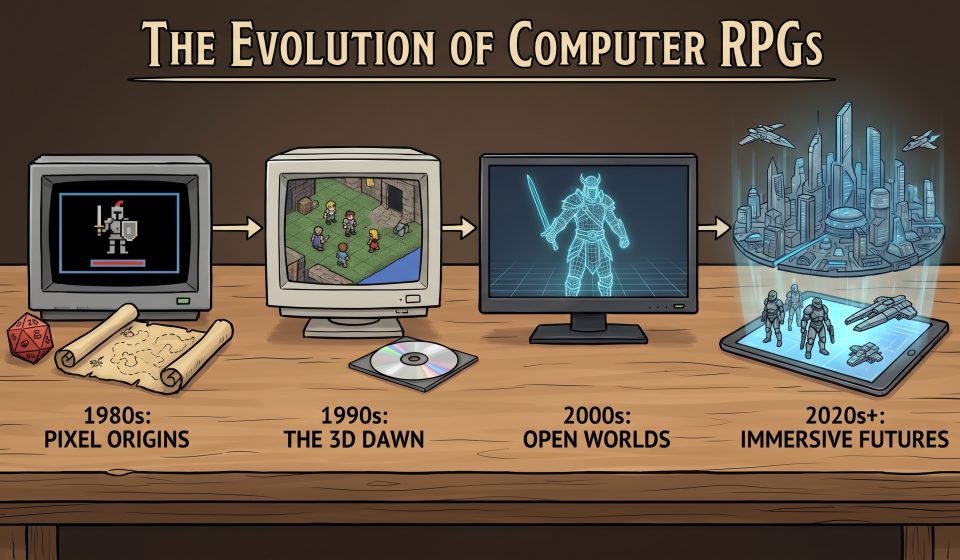

Few development studios have influenced modern role-playing games as profoundly as BioWare.
Founded in 1995, the company became known for ambitious stories, memorable companions, and game worlds that encouraged players to make difficult decisions.
Its October 2026 closure marked the end of more than three decades of development, but its influence continues through games that built on the studio’s ideas.
Understanding BioWare’s legacy means looking beyond individual sales figures or reviews and examining how the studio changed expectations for interactive storytelling.
The Early Years of BioWare
BioWare emerged during a period when computer role-playing games were experimenting with new technologies and storytelling methods.
The studio’s early projects helped demonstrate that detailed characters, tactical combat, and extensive dialogue could work together in commercially successful games.
Its success helped introduce classic RPG design to a wider audience.
Baldur’s Gate and the Rise of Character-Driven RPGs
Baldur’s Gate became a landmark computer RPG by combining Dungeons & Dragons systems with exploration and party-based storytelling.
Players could recruit companions, complete quests, and approach challenges in different ways.
Baldur’s Gate II expanded those ideas through more detailed character interactions and a larger adventure.
These games established foundations for BioWare’s later emphasis on companions and narrative choice.
Neverwinter Nights and Player-Created Adventures
Neverwinter Nights extended BioWare’s RPG approach by supporting tools and systems for user-created adventures.
It demonstrated that role-playing games could become creative platforms rather than only fixed stories produced by developers.
The surrounding community became part of the game’s significance.
Knights of the Old Republic
Star Wars: Knights of the Old Republic showed that BioWare could adapt its RPG formula to an established science-fiction franchise.
It offered character progression, companions, and decisions connected to the light and dark sides of the Force.
Its storytelling helped make it one of the most celebrated Star Wars games.
Jade Empire and Creative Experimentation
Jade Empire moved into a different fantasy setting inspired by martial arts and mythology.
It retained familiar BioWare elements, including dialogue choices and character development, while experimenting with combat.
Although it did not become a major continuing series, it remains a distinctive part of the studio’s history.
The Mass Effect Revolution
Mass Effect introduced a science-fiction universe populated by different civilizations, political institutions, and historical conflicts.
The franchise became particularly influential through its combination of cinematic dialogue and decisions that could carry across games.
Companions developed relationships with the player character, while the larger narrative connected personal stories to galaxy-wide events.
The original trilogy demonstrated the appeal of a connected RPG experience spanning multiple releases.
Dragon Age and Modern Fantasy Storytelling
Dragon Age: Origins established another major BioWare franchise.
Its fantasy world included competing factions, religious institutions, magical conflicts, and political dilemmas.
Later installments experimented with different combat and narrative structures while preserving the importance of companions and character relationships.
The franchise became an important example of how RPGs could explore morally complicated choices.
Why Companions Became So Important
BioWare’s companions often functioned as more than combat assistants.
They had beliefs, personal histories, motivations, and relationships with other characters.
Players could disagree with them, earn their trust, or influence their personal stories.
This design helped make RPG parties feel like groups of individuals rather than collections of abilities.
Modern games continue to use companion quests and relationship systems as major storytelling tools.
Player Choice and Consequences
BioWare popularized a style of storytelling in which players select dialogue responses and make decisions affecting characters and events.
Not every choice changed the entire plot, but the systems created a sense of personal participation.
Mass Effect’s connected trilogy became a particularly visible example of decisions carrying between games.
These ideas encouraged discussion about agency, replayability, and the relationship between player freedom and authored narratives.
BioWare’s Later Experiments
As gaming technology and business models changed, BioWare experimented with different forms of gameplay.
Mass Effect: Andromeda explored a new setting and movement systems.
Anthem emphasized cooperative online action rather than the studio’s traditional single-player storytelling.
These projects generated mixed reactions, but they also demonstrate the challenges of adapting a recognizable creative identity to changing expectations.
What BioWare’s Closure Means
In October 2026, EA announced BioWare’s closure and the end of early development on its next Mass Effect project.
The decision prompted renewed discussion about the studio’s games and the future of its franchises.
For a detailed account, read BioWare Shuts Down in 2026.
Will BioWare’s Influence Continue?
Yes. A development studio’s influence can outlast its operations.
Modern RPGs frequently use cinematic conversations, relationship systems, branching quests, and richly developed companions.
BioWare did not invent every one of these features, but it combined and popularized them in influential ways.
Players and developers will continue to study its successes, experiments, and mistakes.
Where Should New Players Begin?
Mass Effect Legendary Edition is a strong starting point for science-fiction fans.
Dragon Age: Origins offers a more traditional fantasy RPG experience.
Knights of the Old Republic is ideal for players interested in Star Wars storytelling.
For more options, explore our Best BioWare Games ranking.
Final Thoughts
BioWare’s legacy is built on more than individual franchises.
The studio helped demonstrate that role-playing games could deliver memorable characters, complex fictional worlds, and stories shaped by player decisions.
Although its closure ends a major chapter in gaming history, the design ideas it popularized will continue to shape the medium’s future.
Frequently Asked Questions
When was BioWare founded?
BioWare was founded in 1995.
What games made BioWare famous?
Baldur’s Gate, Knights of the Old Republic, Mass Effect, and Dragon Age are among its most influential games.
Did BioWare develop Baldur’s Gate 3?
No. Larian Studios developed Baldur’s Gate 3.
Why is BioWare important?
BioWare helped popularize character-driven storytelling, companion relationships, and meaningful choices in major RPGs.
Is BioWare closing?
BioWare confirmed its closure in October 2026.