

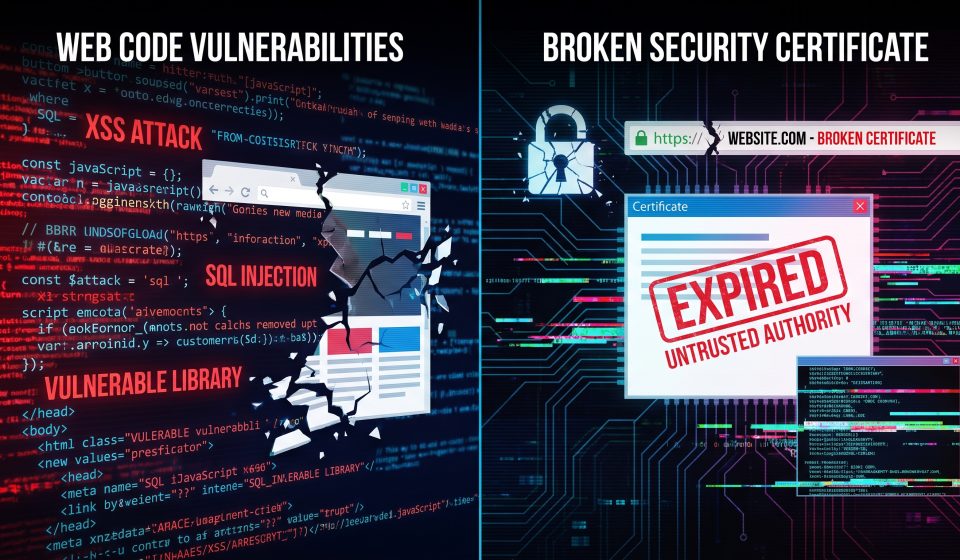
eMudhra vs. PHP Vulnerabilities: Two Major Internet Security Threats Explained

October 2026 brought attention to two significant internet security stories: critical vulnerabilities in PHP and the compromise of private keys associated with eMudhra intermediate certificates.
Both incidents affect website security, but they involve different technologies and different risks.
Understanding the distinction helps website owners avoid applying the wrong fix to the wrong problem.
What Happened With PHP?
The PHP development team announced an emergency security release for two critical vulnerabilities, CVE-2026-109618 and CVE-2026-109619.
Initial advisories described the vulnerabilities as potentially enabling remote code execution under affected conditions.
PHP is a server-side programming language used by many websites and applications.
A vulnerability in its runtime can create risks for systems executing affected PHP code.
What Happened With eMudhra?
Mozilla reported that private keys associated with eight eMudhra intermediate certificate authority certificates had been compromised.
Such keys could potentially be used to create fraudulent HTTPS certificates.
Browser and trust-store operators responded by blocking affected certificates and distributing security updates.
The Key Difference
The PHP incident concerns the software responsible for executing application code.
The eMudhra incident concerns the system used to establish trust in HTTPS certificates.
One can affect the server-side application environment. The other can affect whether a client trusts the identity presented by a server.
Can HTTPS Protect Against a PHP Vulnerability?
No. HTTPS protects data transmitted between the browser and server, but it does not fix vulnerabilities in PHP itself.
A website can have a valid HTTPS certificate while running vulnerable application software.
Can Updating PHP Fix a Compromised Certificate Authority?
No. PHP updates address the runtime. Certificate trust problems require appropriate browser, operating system, certificate provider, or trust-store responses.
Which Incident Is More Dangerous?
There is no useful universal ranking. The practical risk depends on the affected environment and exposure.
A vulnerable public-facing PHP application may require urgent remediation. A system trusting compromised certificate authorities may require certificate trust updates.
Organizations should evaluate both risks separately.
What Should Website Owners Do?
Maintain an inventory of server-side software and TLS certificates.
Apply official PHP security fixes to affected systems, keep browsers and operating systems updated, and review certificate chains when an incident warrants it.
Monitor authoritative advisories rather than relying on sensational headlines.
Related Guides
Read Critical PHP Vulnerabilities 2026 and eMudhra Certificate Compromise Explained for detailed incident coverage.
Frequently Asked Questions
Are PHP and eMudhra connected?
They are separate technologies. Their security incidents occurred around the same period but involve different systems.
Does a valid SSL certificate mean my PHP website is secure?
No. A valid certificate does not guarantee that the server-side application is free of vulnerabilities.
Can an HTTPS certificate compromise affect users?
Under certain conditions, compromised certificate signing keys can facilitate website impersonation.
What is the main fix for PHP vulnerabilities?
Apply official security updates to affected PHP runtimes and follow vendor guidance.
What is the main response to compromised CA keys?
Certificate trust and revocation updates, plus appropriate action by affected certificate providers and administrators.